
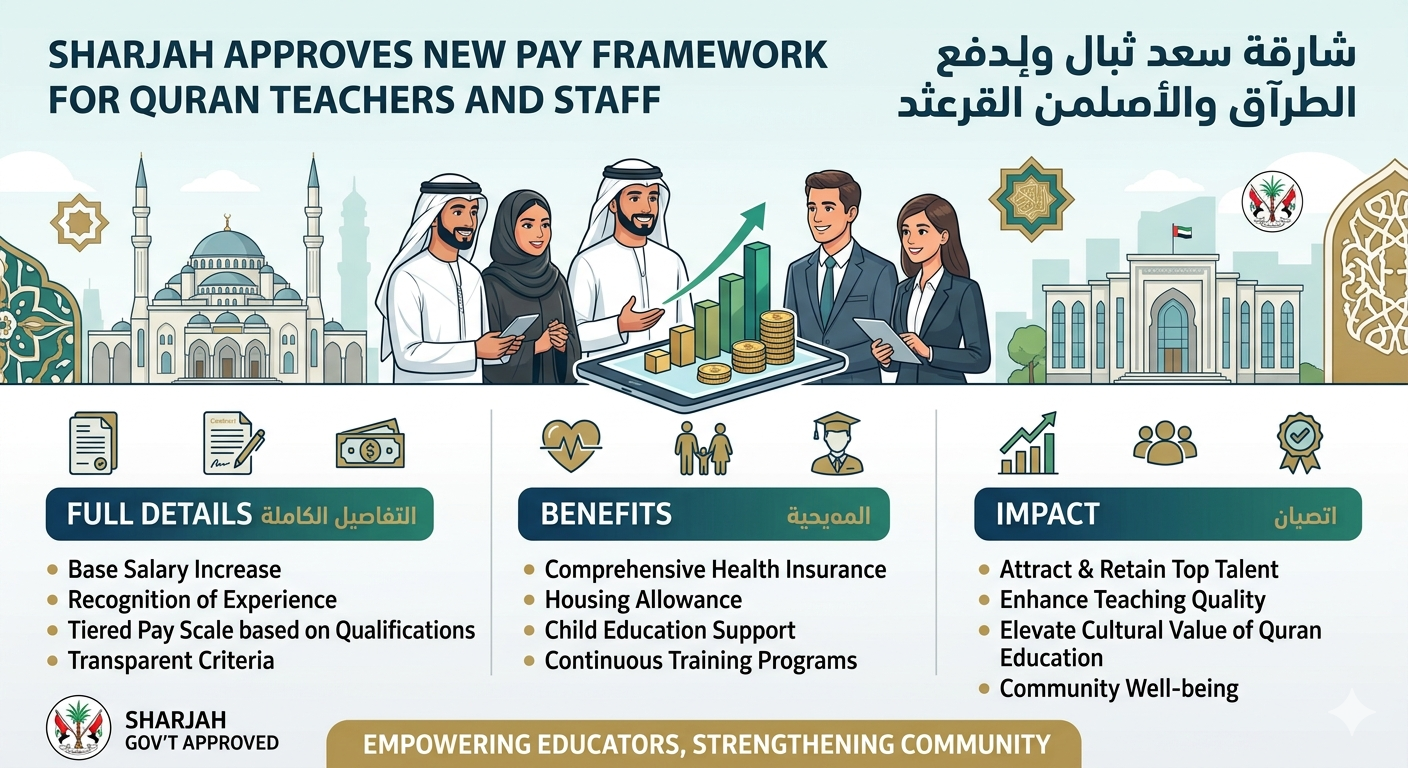
Sharjah Approves New Pay Framework for Quran Teachers and Staff – Detailed Report
Sharjah has introduced a significant reform in its religious education sector by approving a new pay framework for Quran teachers and administrative staff working under the Sharjah Noble Quran and Sunnah Establishment. This decision represents a major step toward improving working conditions, strengthening institutional performance, and ensuring high-quality Quranic education across the emirate.
The initiative reflects Sharjah’s long-standing commitment to supporting Islamic education and recognizing the vital role of Quran teachers in shaping moral, spiritual, and educational development within society. The new framework is designed not only to enhance salaries but also to bring structure, transparency, and professional standards to the entire system.
Background of the Decision
The Sharjah government has consistently invested in religious and educational development, with special attention given to Quran memorization centers, Islamic studies programs, and teacher training initiatives. Over the years, Quran teachers have played a central role in nurturing generations of students who learn recitation, memorization (Hifz), and interpretation of the Holy Quran.
However, previous compensation structures were often seen as less standardized, with limited clarity regarding salary grades, performance evaluation, and career progression. This created inconsistencies in motivation levels and administrative efficiency.
To address these challenges, the Sharjah authorities approved a new pay framework that introduces a more organized and fair compensation system. The goal is to ensure that teachers and staff receive appropriate recognition for their efforts while maintaining high educational standards.
What the New Pay Framework Includes
The newly approved system is not just a salary revision; it is a comprehensive restructuring of compensation and employment policies within the Quran education sector.
1. Structured Salary System
One of the key features of the framework is the introduction of a structured salary scale. This system categorizes Quran teachers and staff into different levels based on:
- Qualifications
- Years of experience
- Job responsibilities
- Performance evaluation
This ensures that employees are compensated fairly according to their role and contribution.
2. Performance-Based Incentives
The new framework includes performance-linked incentives. Teachers who demonstrate excellence in student outcomes, teaching quality, and administrative discipline may receive additional benefits.
This approach encourages continuous improvement and rewards dedication and professionalism.
3. Clear Job Classification
Previously, some roles within Quran education institutions were not clearly defined. The updated framework introduces well-defined job descriptions for:
- Quran teachers
- Senior instructors
- Supervisors
- Administrative staff
- Support personnel
This clarity helps reduce confusion and ensures accountability at all levels.
4. Improved Benefits and Allowances
In addition to basic salaries, the framework introduces improved allowances, which may include:
- Housing support (where applicable)
- Transport assistance
- Professional development opportunities
- Training programs
These benefits aim to improve overall job satisfaction and retention.
5. Career Development Pathways
Another important feature is the introduction of career progression opportunities. Teachers will now have clearer pathways for promotion based on experience, qualifications, and performance.
This ensures long-term career growth within the institution rather than stagnation in fixed roles.
Objectives of the New Framework
The new pay structure has been introduced with several strategic objectives in mind:
1. Enhancing Quality of Quran Education
By improving teacher motivation and satisfaction, the system aims to directly enhance the quality of Quran learning for students.
2. Attracting Qualified Educators
A more competitive salary structure will help attract highly qualified Quran teachers from within the UAE and abroad.
3. Strengthening Institutional Efficiency
Clear job roles and performance standards will improve administrative efficiency and reduce operational inconsistencies.
4. Promoting Fairness and Transparency
The structured system ensures that all employees are treated fairly based on defined criteria rather than informal arrangements.
5. Supporting Religious and Cultural Values
Sharjah continues to emphasize its identity as a cultural and Islamic education hub, and this framework strengthens that vision.
Role of Sharjah Noble Quran and Sunnah Establishment
The Sharjah Noble Quran and Sunnah Establishment is a key institution responsible for Quran memorization programs, teacher training, and Islamic educational initiatives in the emirate.
Under the new framework, the institution will play a central role in:
- Implementing salary structures
- Evaluating teacher performance
- Managing training programs
- Supervising administrative compliance
This ensures that the framework is not only theoretical but actively integrated into daily operations.
Expected Impact on Teachers and Staff
The introduction of the new pay framework is expected to bring several positive outcomes for employees.
Improved Financial Stability
Teachers and staff will benefit from more stable and predictable income structures, reducing financial uncertainty.
Increased Motivation
Performance-based rewards and recognition are expected to boost morale and encourage higher levels of dedication.
Better Work Environment
Clear job roles and expectations will reduce workplace stress and improve organizational harmony.
Professional Growth
Training and promotion opportunities will allow teachers to build long-term careers in Quran education.
Impact on Students and Education Quality
While the framework directly targets employees, its ultimate beneficiaries are students. Improved teacher satisfaction and performance will lead to:
- Better Quran memorization outcomes
- Improved teaching methods
- More structured learning environments
- Increased student engagement
- Higher retention in Quran programs
This creates a positive cycle where better teacher support leads to better student success.
Broader Social and Educational Significance
This reform is not only an administrative update but also a reflection of Sharjah’s broader vision for society. The emirate has consistently emphasized education, cultural identity, and Islamic values as core pillars of development.
By investing in Quran teachers, Sharjah is reinforcing:
- The importance of religious education
- The dignity of teaching professions
- The preservation of Islamic knowledge
- Community moral development
It also aligns with global trends where education systems are being modernized with performance-based structures and transparent compensation systems.
Challenges and Considerations
While the framework brings many benefits, its implementation may also involve certain challenges:
1. Adjustment Period
Teachers and administrators may require time to adapt to the new system and evaluation methods.
2. Performance Measurement
Ensuring fair and accurate performance evaluation in educational settings can be complex.
3. Budget Allocation
Sustaining improved salary structures requires long-term financial planning and government support.
4. Training Requirements
Staff may need training to understand new administrative procedures and expectations.
Despite these challenges, the long-term benefits are expected to outweigh initial difficulties.
Future Outlook
The introduction of this pay framework may serve as a model for other educational and religious institutions in the region. If successfully implemented, it could inspire similar reforms across the UAE and beyond.
In the future, further enhancements may include:
- Digital performance tracking systems
- Advanced teacher training programs
- Expanded scholarship opportunities for educators
- Greater integration of technology in Quran learning
Such developments would further strengthen the education ecosystem and maintain Sharjah’s reputation as a center of Islamic learning.
Conclusion
The approval of the new pay framework for Quran teachers and staff in Sharjah marks a major milestone in the emirate’s educational and religious development strategy. By introducing structured salaries, performance-based incentives, clear job roles, and career progression opportunities, the system aims to uplift both educators and the quality of Quranic education.
This reform reflects a broader vision of fairness, excellence, and sustainability in education. More importantly, it recognizes the invaluable contribution of Quran teachers in shaping the spiritual and moral foundation of society.
Ultimately, the initiative is expected to create a more motivated teaching workforce, improved learning outcomes for students, and a stronger institutional framework that supports Islamic education for years to come.
FAQs
1. What is the new pay framework in Sharjah about?
It is a structured salary and benefits system introduced for Quran teachers and staff to improve compensation, performance standards, and career development.
2. Who will benefit from this framework?
Quran teachers, supervisors, and administrative staff working under the Sharjah Noble Quran and Sunnah Establishment.
3. Does the framework only include salary increases?
No, it also includes job classifications, performance-based incentives, allowances, and career progression pathways.
4. Why was this system introduced?
To improve teacher motivation, ensure fairness in compensation, and enhance the quality of Quran education.
5. How will it affect students?
Students are expected to benefit indirectly through better teaching quality, improved learning environments, and more motivated instructors.
6. Is this part of a wider government plan?
Yes, it aligns with Sharjah’s broader goals of strengthening education, cultural identity, and Islamic values.